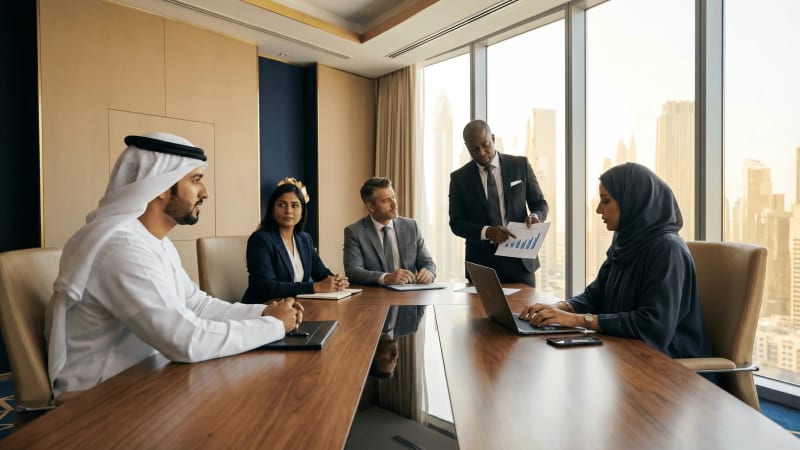
In Kuwait's private sector, roughly 96 out of every 100 workers are not Kuwaiti. In Saudi Arabia, the figure is close to 80. That means the average meeting room in the Gulf holds people who grew up with different languages, different ideas about bosses, and different ways of saying "no". Multicultural team communication in the GCC is not a soft extra. It decides whether work gets done right the first time. This guide shows where messages break down, what the research says, and nine habits you can start using this week.
Why Communication Breaks Down in GCC Teams
Most communication problems in Gulf teams are not about bad attitude. They come from smart people using the same English words while hearing very different meanings.
Picture a simple, everyday scene. A manager asks, "Can you finish the report by Thursday?" One team member says, "I will try." To the manager, that sounds like a yes. To the speaker, it may have been a polite way of saying the deadline is not realistic. Nobody lied. Nobody was rude. Yet the report is late, and both people feel let down.
How International Is the GCC Workforce?
The scale of the mix is what makes the Gulf different. According to the Gulf Labour Markets, Migration and Population (GLMM) programme, which compiles official national statistics, non-nationals made up the large majority of private-sector workers across the GCC in 2024.
Country
Private-sector workers (2024)
Non-nationals
Non-national share
Qatar
1,775,873
1,765,650
99.4%
Kuwait
1,739,735
1,665,994
95.8%
Saudi Arabia
11,837,519
9,429,359
79.7%
Oman
1,837,840
1,433,124
78.0%
Source: GLMM, compiled from national statistics offices (GASTAT for Saudi Arabia, Kuwait's Central Statistical Bureau, Oman's NCSI, Qatar's National Planning Council). The UAE and Bahrain have no 2024 sector breakdown in this dataset.
Non-national share of private-sector workers by GCC country, 2024 (GLMM data).
The UAE is just as diverse. GLMM estimates that foreign citizens made up about 87% of the UAE's population in 2022. Across the region, its February 2025 factsheet, drawing on UN data, reports that the six Gulf states hosted around 10.1% of all migrants worldwide in 2024, up from 5% in 1990.
What this table tells a team leader is simple. In most Gulf workplaces, there is no "majority culture" to fall back on. Every team has to build its own shared way of talking.
English as the Shared Language, and Its Limits
English is the default working language in most Gulf offices. That helps, but it also hides problems. A team can look fluent on the surface while people quietly misread each other.
A 2025 peer-reviewed study by Kania Chowdhury in the Emirati Journal of Education and Literatures looked at exactly this. It gathered responses from 20 expatriate professionals of different nationalities working in the UAE. The study found that uneven English levels, accent and pronunciation differences, and clashing communication styles regularly led to misunderstandings, wasted time, and workplace conflict. It also found these barriers can hold back individual career growth.
The sample is small, so treat it as a clear signal rather than a final verdict. Still, it matches what many Gulf managers will recognise from their own meetings.
What Are the Biggest Barriers to Multicultural Team Communication in the GCC?
Communication barriers in GCC multicultural teams are the language, cultural, and structural gaps that stop a message from being understood the way it was meant. The five most common are:
1. Uneven English proficiency and unfamiliar accents
2. Direct versus indirect speaking styles (low-context and high-context cultures)
3. Strong respect for hierarchy, also called high power distance
4. Bad news and disagreement that never get said out loud
5. Knowledge gaps between national and expatriate colleagues
Language Proficiency and Accents
A colleague who speaks English as a third language may follow a slow, clear presentation perfectly well. The same person can lose the thread in a fast call full of idioms like "let's circle back" or "touch base". When people are embarrassed to ask, they nod and guess.
Direct vs Indirect Styles
Some people say exactly what they mean. Others expect listeners to read between the lines, the tone, and the relationship. Neither is wrong. Trouble starts when a direct speaker takes a polite hint as agreement, or an indirect speaker hears plain feedback as an insult.
Hierarchy and Power Distance
Dutch researcher Geert Hofstede measured how much people in different countries accept unequal power between bosses and staff. He called this power distance. Saudi Arabia scores very high on his scale, and the wider Arab region also scores high. In practice, this means junior staff may not challenge a manager's plan, even when they can see a flaw in it.
Unspoken Bad News and Silent Disagreement
Put the last two barriers together and you get the most expensive one. People who are both indirect and respectful of rank often avoid delivering bad news to a senior person. Problems stay hidden until they are too big to fix quietly.
Knowledge Gaps Between Nationals and Expatriates
Nationalisation programmes such as Emiratisation and Saudisation are bringing more Gulf nationals into private-sector teams. When experienced expatriates and new national hires do not share know-how openly, both sides lose. Our guide to nationals and expats working together covers the HR side of this shift in detail.
Is the UAE a High-Context or Low-Context Culture?
Emirati and wider Gulf Arab business culture leans high-context. Meaning often sits in relationships, tone, and what is left unsaid, not only in the words.
The idea comes from anthropologist Edward T. Hall. In low-context cultures, such as Germany or the Netherlands, people expect clear, literal messages. In high-context cultures, people rely more on shared understanding and polite indirectness.
The catch in the UAE is that most teams are not Emirati. A single project team in Dubai or Abu Dhabi can mix high-context and low-context speakers in the same room. So the useful question is not "What is the UAE's culture?" It is "What does this team need to make meaning clear?" Individuals also vary a lot, so use the framework as a starting point, never a stereotype.
9 Proven Habits for Better Communication in Multicultural Teams
These habits are practical and low-cost. None of them need a big training budget, and most can start in your next meeting.
A short written summary after each meeting keeps a mixed team aligned.
1. Write It Down After Every Meeting
Send a short written summary within a few hours: what was decided, who owns each task, and the deadline. Written notes help colleagues who missed a point because of accent or speed. They also give quieter team members a second chance to raise a concern. This one habit fits neatly with the wider advice on building a high-performing team.
2. Use Plain English and Check Understanding
Swap idioms for direct words. Say "Please send it by 2pm Thursday" rather than "Can you get it over the line this week?" Then ask an open question to check understanding, such as "What will you do first?" A closed question like "Is that clear?" almost always gets a polite yes.
3. Ask for Input Privately, Not Only in the Room
In high power distance teams, people may not disagree with a manager in front of others. Follow up one-to-one, or ask for written comments before a decision is final. You will hear concerns that never surface in a group call.
4. Give Feedback Privately and Specifically
Public criticism can cause real loss of face, especially for colleagues from cultures where reputation and respect matter deeply. Give corrective feedback in private. Make it about the work, not the person: "The figures in section 3 do not match the source file" lands far better than "This is careless."
Corrective feedback works best in private and focused on the work.
5. Make It Safe to Report Problems Early
Tell your team, more than once, that early bad news is welcome and late bad news is the real problem. Then prove it by thanking the first person who flags a risk. This builds psychological safety, the shared belief that speaking up will not be punished. Without it, the hierarchy barrier wins every time.
6. Invest in Relationships Before Deadlines
In relationship-first cultures, trust often comes before efficiency. A short coffee chat, asking about someone's family or Eid plans, or eating lunch together is not wasted time. It is how people decide whether they can be honest with you when the pressure is on.
7. Plan Around Different Weekends and Ramadan Hours
Cross-border Gulf teams do not share one calendar.
1. UAE: Federal government entities moved to a Saturday and Sunday weekend, with a half-day Friday, from 1 January 2022, as announced through the official WAM news agency.
2. Saudi Arabia: The government weekend has been Friday and Saturday since a royal decree in June 2013. Private-sector schedules vary by employer.
3. Ramadan: In February 2026, the UAE Ministry of Human Resources and Emiratisation (MoHRE) confirmed that private-sector working hours are cut by two hours a day during the holy month, with flexible or remote options allowed within those limits.
A practical rule follows from this. Book cross-border calls on days both offices work, usually Monday to Thursday. During Ramadan, schedule important meetings early in the shorter working day, and never assume a colleague can stay late. Teams on large regional builds will find more scheduling tips in our guide to project management on Gulf mega projects.
8. Set WhatsApp and Channel Rules
WhatsApp is widely used for work in the Gulf, and it blurs work and personal time. Agree as a team which channel is for what. For example: email for decisions, a project tool for tasks, WhatsApp only for urgent same-day issues. Also agree on quiet hours. This protects everyone, but it especially helps colleagues who feel they cannot ignore a senior person's late-night message.
9. Train Cultural Intelligence, Not Stereotypes
Cultural intelligence (CQ) is the skill of noticing cultural differences and adjusting how you act. It is different from memorising "rules" about nationalities, which often turn into lazy stereotypes. Good CQ training teaches active listening, curiosity, and how to ask "How do you prefer to get feedback?" It sits alongside the wider soft skills Gulf employers value, and it is one of the most transferable.
UAE vs Saudi Arabia: What Changes Across Borders
Many Gulf teams now run projects across the UAE and Saudi Arabia at once. Here is what a team lead should plan for.
Factor
UAE
Saudi Arabia
Foreign share
About 87% of the population are foreign citizens (GLMM estimate, 2022)
79.7% of private-sector workers are non-nationals (GLMM, 2024)
Government weekend
Saturday and Sunday, plus half-day Friday (since January 2022)
Friday and Saturday (since June 2013)
Nationalisation programme
Emiratisation
Saudisation
Practical tip
Very wide nationality mix, so default to plain English and written follow-ups
Growing number of Saudi nationals in private roles, so build in knowledge sharing and mentoring
One more cross-border tip: do not treat the Gulf as one culture. Formality, pace and decision-making style can differ between countries, and between companies in the same city.
What the Research Says About UAE Workplaces
Published research on Gulf team communication is still limited, but two UAE studies stand out.
1. Chowdhury (2025): The study of 20 expatriate professionals found that language level, pronunciation, cultural norms, and communication style all feed misunderstandings and conflict. It also points to Hofstede's work, noting that high power distance can block open communication and slow down problem-solving and innovation.
2. Al-Jenaibi (2012): Published in GEOGRAFIA Online, this study surveyed 450 foreign workers in the UAE and interviewed local officials. Employees generally viewed workplace diversity positively. Yet a significant share doubted that their employer could actually put good intercultural communication practices into action.
Together, these studies point to the same gap. Goodwill is not the problem. Practical habits are. Most people in Gulf teams want to work well across cultures. They need simple routines that make it easier. For the policy layer behind this, see our guide to diversity and inclusion in the Gulf.
FAQ
The main barriers are uneven language skills, direct versus indirect speaking styles, respect for hierarchy, unspoken disagreement, and knowledge gaps between colleagues. In the Gulf, these are amplified because most teams have no single majority culture.
Use plain English, confirm decisions in writing, check understanding with open questions, and give feedback privately. Ask for input one-to-one as well as in meetings, and agree on team rules for channels like WhatsApp.
Emirati business culture leans high-context, relying on relationships and indirect cues. However, most UAE teams mix many nationalities, so the team itself usually needs clear, low-context habits such as written summaries.
Give corrective feedback privately, focus on the work rather than the person, and be specific. Ask each team member how they prefer to receive feedback, because expectations differ widely.
Yes. English is the main shared working language in most private-sector Gulf offices. Proficiency and accents vary a lot, though, so plain language and written follow-ups prevent costly misunderstandings.
Conclusion
Gulf teams bring together more nationalities than almost anywhere else, and that mix is a real strength. It only pays off when messages land the way they were meant. Clear writing, private feedback, early warnings, smart scheduling and genuine relationships solve most problems before they start.
Strong multicultural team communication in the GCC does not depend on perfect English or a long training course. It depends on small habits, repeated every week, until they become how your team works.
Which of these nine habits does your team need most? Share it in the comments, and pass this guide to a team lead who is managing a mixed team right now.
Published by Gulf Certifications
Gulf Certifications Editorial Team
Published by Gulf Certifications, a GCC-focused resource on professional certifications, HR and project management. Its guides draw on official Gulf government data, national statistics and peer-reviewed research to help professionals across the region work and lead with confidence.
Build Stronger Multicultural Team Communication
Explore our Gulf guides on HR, leadership, and project management to grow your skills across the GCC.